The mission of the Lawrence History Center is to collect, preserve, share, and interpret the history and heritage of Lawrence and its people. Please explore our website, and let us know how we can help. Read our recent news below...

Former Mayor Lawrence P. LeFebre Visits the LHC

LeFebreVisit.jpgOn Friday morning, May 10, 2013, LHC proudly welcomed Former Mayor Lawrence P. LeFebre, along with his wife and sister, to our archive for a visit and tour. Mayor Lefebre, pictured here with LHC Director, Susan Grabski (left), and LHC Archivist, Jennifer Williams, was in office between 1978 and 1983. During this time, the Immigrant City Archives (now dba Lawrence History Center) was founded by Eartha Dengler, the Lawrence Heritage State Park opened, and several buildings were registered as historical landmarks.

In 2006, Mayor Lefebre generously donated his papers to the History Center so that the history and his legacy may be preserved and made available for researchers. The Mayor Lawrence P. LeFebre Papers, 1849-2005, includes photographs, various types of correspondence, as well as plaques and other objects. The materials have been arranged, described, and made available to researchers worldwide through an online Finding Aid (or Collection Guide) on our web site. The following is an excerpt from the Finding Aid’s Biographical Note (full Finding Aid):

“During his six years in office Mayor LeFebre developed multiple projects. Indeed, he was very involved in rehabilitating the infrastructure in Lawrence. He obtained federal and state money to conduct such activities as install a new water tower and water lines as well as renovate the historic water tower, renovate the downtown area, and establish a Design Review Board to ensure that all rules in the historic district were observed. He also initiated the process of having five Lawrence neighborhoods included on the National Historic Register and established programs to rehabilitate and preserve historic homes.

Promoting Local History: LHC Works With High School Students

The history of Lawrence is rich, and includes many topics of regional and national significance. Immigration, urban redevelopment, industrialization, suburbanization, and labor are all themes that run throughout the city's history. The mission of the Lawrence History Center is not only to collect and preserve this history, but also to share, promote, and interpret it. We have been doing this in recent weeks by working with students from Lawrence High School and Phillips Academy.

PAClass.pngMark Cutler, a Spanish teacher at Phillips Academy in Andover, has been working with a group of seniors to create a documentary focusing on Lawrence. It involves conducting oral histories with many different people in Lawrence, including seniors, high school students, and business owners. He asked if staff member Jennifer Williams would be willing to teach a class on how to prepare for and actually conduct oral history

Lawrence History Center contributes to the launch of "the greatest digital history project of all time"

DPLA_web-banner_final.jpg

"We are bringing together the richest of America's archives and museums, and making them easily searchable for teachers, scholars, journalists and others," said Dan Cohen, the DPLA executive director, who left his position as a history professor at George Mason University
to focus on "the greatest digital history project of all time."

(US digital library brings culture, history online, The Economic Times, 14.Jan.2013.)

Today, April 18, 2013, the Lawrence History Center is proud to be part of the launch of the DPLA with our online exhibition, Bread and Roses Strike of 1912: Two Months in Lawrence, Massachusetts, that Changed Labor History. We, in partnership with the University of Massachusetts Lowell History Department, have contributed a much enhanced version of an exhibition originally created by LHC and UMass Lowell students to commemorate the Centennial Anniversary of the 1912 Bread and Roses Strike.

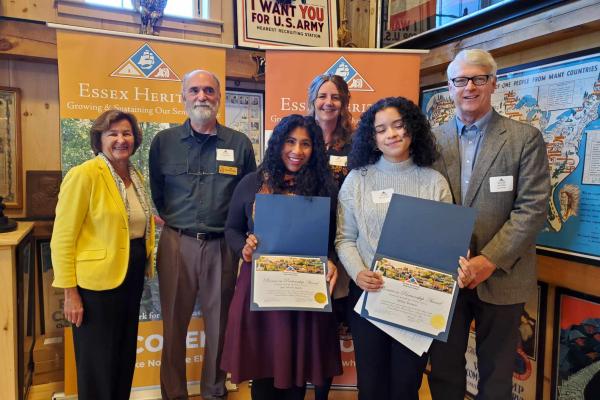
LHC the recipient of a 2013 Essex Heritage Partnership Grant!

alice_oconnor_child_sm.jpg
full_blackletters_150px.gif logo_0.jpg

The Lawrence History Center is proud to be the recipient of a 2013 Essex Heritage Partnership Grant! Because of this award and matching funding from the Merrimack Valley General Fund (ECCF), LHC will be able to conduct an archival processing project entitled, "The Alice Winifred O’Connor Collection Online."

In the archives of the Lawrence History Center we have a collection of diaries, photographs, and professional research of Alice O’Connor (1887—1968), a single woman who was born, raised and educated in Lawrence, at the height of immigration to the United States. She championed the rights of newcomers to Massachusetts and Lawrence and had compassion and a passion to help improve living conditions, education for immigrant children and to develop just laws for immigrants.

The selection of this collection was done as part of our Strategic Framework, 2013 - 2015. Immigration and Cultural Diversity is one of three core themes identified as being fundamental to the early history of Lawrence, representative of an area of significant strength in the LHC collections, and as having dynamic currency and importance in Lawrence today. Through this collection, and others, we hope to further educate a generation of residents in Lawrence about the immigrant populations that have preceded them, build civic pride and sense of place, and to make history relevant in their lives today.

Processing an archival collection involves organizing the items, adding them to our digital repository, and developing a Collection Guide (also known as a finding aid) so that the collection may be searchable and accessible to researchers — students and teachers — of all ages online and within our research facility. We are excited to begin work on the Alice Winifred O’Connor Collection! To view examples of other LHC Collection Guides, please visit http://www.lawrencehistory.org/node/20823.

From the Everett Mill, to Phillips Academy, to UMass Lowell: "The Hine Project: Stories of the Lawrence Children" has moved again!

hine_uml.pngWe are delighted to announce that the centennial exhibit, "The Hine Project: Stories of the Lawrence Children, by Joe Manning" has moved from the McLean Gallery in the Oliver Wendell Holmes Library at Phillips Academy in Andover to the O'Leary Library at the University of Massachusetts Lowell (South campus). It will be incorporated into course curriculum and remain on campus through the spring semester.

"The children and families depicted in the child labor photographs of Lewis Hine were unwittingly caught in the act of making history, but we know almost nothing about them. The pictures were taken for a noble purpose, but a century later, they have become an enormous photo album of the American Family. By finding out what happened to some of them, and by revealing the photos to their descendants (most descendants are unaware of them), we are dignifying their lives, and the lives of everyone that history has forgotten."
~ Joe Manning

The exhibit first opened in April 2012 on the 6th floor of the Everett Mill within our bilingual exhibit, "Short pay! All out! The Great Lawrence Strike of 1912." While at the Everett, it drew interest from thousands of visitors with varied interests -- Lewis Hine, the Strike, child labor, genealogy, photography, immigration to name a few.

The exhibit's stay in O'Leary Library at the University of Massachusetts Lowell has been made possible by the Lawrence History Center and Professor Robert Forrant (UMass Lowell History Department), in cooperation with George Hart, Director of UML Libraries. Special thanks to Paige Roberts (Archivist, Phillips Academy) and PA movers, Billy and Jose, who took great care in delivering the exhibit to Lowell. Thanks also to Tony Sampas and Shawn Sullivan at the O'Leary Library who eagerly helped to set-up the exhibit in the O'Leary Library Learning Commons.

"The Hine Project: Stories of the Lawrence Children, by Joe Manning" is sponsored by the Bread and Roses Centennial Committee and funded by the Lawrence History Center and the UMass President's Office.

Three New Church Collections Available by Veronica Denison

ChurchCollections1.jpg The Lawrence History Center is proud to announce three new collections that are available for research: the Church of the Good Shepherd Unitarian Universalist Collection, 1847-1980; the First Universalist Society of Methuen Collection, 1924-1959; and the First Spiritual Church of Methuen Collection, 1887-1974.

The First Spiritual Church of Methuen was called the First Progressive Society of Lawrence until the Society built a church in Methuen and changed their name. As defined by the Society, “Spiritualism is the science, philosophy and religion of continuous life, based upon the demonstrated fact of communication, by means of mediumship, with those who live in the Spirit World.” The records of the First Spiritual Church of Methuen go until 1974. It is unclear what became of the Church and Society.

Lawrence Businesses Through the Years

BusinessExhibit.JPGThere is a new display at the Lawrence History Center. The Lawrence Businesses Through the Years exhibit case displays objects, advertisements, and photographs of six different Lawrence businesses. While Lawrence is mostly known for its numerous mills, such as the Wood Mill (included in the exhibit - see the above photograph), which was constructed in 1905 by William Wood, there were also many other businesses that were owned and operated by Lawrence residents.

Local Researcher Highlights the History of Lawrence's Boxing Scene

lewis_boxing.jpg
ANGIE BEAULIEU/Staff photo

Christine Lewis (left) organized an exhibit about Lawrence's legendary boxing history at Pizza King, owned by John Sapienza (right). The exhibit at the pizza shop highlights the history of Lawrence's boxing scene. We applaud Christine for continuing to tell stories of Lawrencians and, in this case, for partnering with a local business to present the story in an unexpected venue. Thank you to both Christine and John!

The story was featured on the front page of today's Eagle Tribune. Read more at:
http://www.eagletribune.com/local/x1121363980/Exhibit-shows-Lawrences-st...

Urban Development in Lawrence: UMASS Amherst Students Visit the LHC

IMG_2318.JPGThe city of Lawrence was created in the mid-19th century as a planned mill town. The Essex Company created a dam and canals for the sole purpose of bringing textile mills and workers to the area. The Company designed the layout of the town, including where the boarding houses and churches would be located. The city grew exponentially in the subsequent decades, as the Arlington Mills, Wood Mill, and many other companies were established. Immigrants came to the city and built their own churches and businesses, and the city thrived. However, by the 1950s the mills were leaving the city for the south, where labor was cheaper. In an attempt to revitalize the city, several urban renewal projects were developed. Many buildings, some old and dilapidated, were torn down and space was made for new businesses. Due to this history, Lawrence has been of extreme interest to regional planners and landscape architects.

Last Friday, twenty-five students from the University of Massachusetts, Amherst came to the Lawrence History Center in order to research the development of the city. They are all participating in a capstone project for the Landscape Architecture and Regional Planning Department in conjunction with Groundwork Lawrence. Their interests were mainly in the development of the mills as well as changes in the city over time, especially along the canals. They used a wide variety of materials, including maps, atlases, blueprints, deeds, and ledgers. Using these materials they started to piece together the history of Lawrence's development, and many found that there were so many resources that they would need to return at a later date. They loved looking at the original documents, and were amazed at the availability of records dating back to the founding of the city. The LHC staff really enjoyed working with them, and look forward to similar collaborations in the future.

Syndicate content